
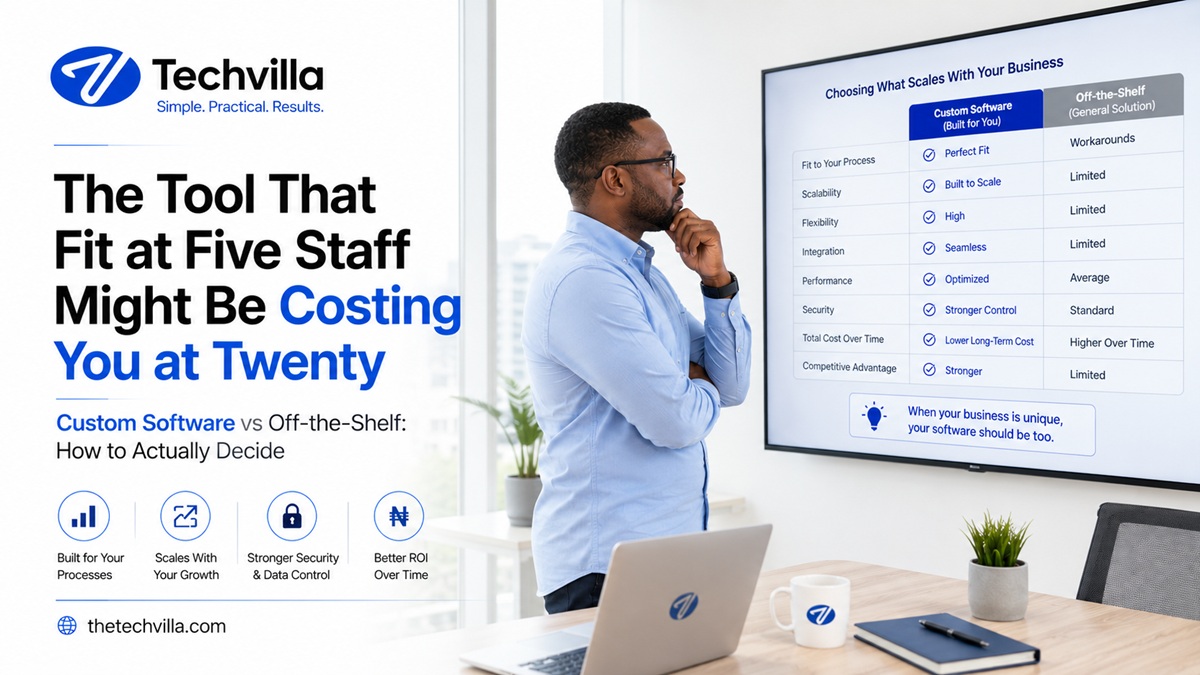
Every growing Nigerian business eventually hits the same wall. The spreadsheet that worked fine with five staff members starts breaking down at twenty. The generic booking tool that got you through your first year of bookings now forces your team into awkward workarounds just to get basic things done. At that point, a decision that once felt like simple procurement becomes something with real, lasting consequences: do you buy an off-the-shelf tool, or invest in custom software built specifically around how your business actually works?
What Off-the-Shelf Software Actually Gets You
Off-the-shelf software, sometimes called commercial off-the-shelf or COTS, refers to ready-made products built to serve a broad range of businesses with similar, standard needs: accounting platforms, generic CRMs, inventory tools, booking systems. The appeal is real and should not be dismissed. These tools are fast to deploy, relatively affordable to start with, and require no development time before you can begin using them.
Off-the-shelf genuinely wins when your process is standard. If your business runs a workflow that thousands of other businesses run the same way, invoicing, basic scheduling, standard payroll, there is little value in rebuilding something that already exists and works well. Paying to custom-build a solution for a genuinely standard process is expensive imitation of something you could simply buy.
Where Off-the-Shelf Software Starts Costing You
The problem shows up gradually, not immediately, which is precisely why so many businesses get caught off guard by it. A tool that fit comfortably at seven staff and a few thousand records can stop fitting entirely once a business grows to twenty-five staff and hundreds of thousands of records. The tool itself has not changed. The business has outgrown the assumptions the tool was originally built around.
This shows up as what analysts now call a workflow tax, the accumulated cost of your team constantly adapting how they actually work to match a generic tool's rigid assumptions, rather than the tool adapting to your business. It also shows up as integration sprawl. The average business today runs close to 900 different apps, yet fewer than a third of them are properly connected to each other, meaning staff waste real time jumping between disconnected systems just to complete a single task. For Nigerian startups specifically, there is an additional, sharper version of this problem: a subscription tool is rented infrastructure. Stop paying, and your data and your workflow vanish with it. A custom-built system, by contrast, becomes a genuine company asset on your balance sheet, something that can meaningfully increase your valuation when you are raising funding or preparing for acquisition.
The Question That Actually Matters
The smarter question in 2026 is not simply "which option is better?" It is "does this specific capability need to be unique to how my business operates, and can I responsibly plan to run and maintain it if I build it myself?"
A useful way to think about this: off-the-shelf makes sense when the software supports a standard, generic function, basic administrative tasks, common accounting workflows, processes that look the same across thousands of businesses in your industry. Custom software makes sense when the software drives your actual competitive advantage, when it needs to house proprietary logic specific to your business, or when your workflow genuinely is the differentiator that makes your business succeed where competitors do not.
This is exactly the territory we described when discussing Nigeria's new e-invoicing mandate and the identity verification standards platforms now need to meet. Both are situations where a generic, off-the-shelf tool almost certainly will not have been built with your specific regulatory obligations in mind, and retrofitting compliance onto a rigid, generic system after the fact is often harder and more expensive than building it correctly from the start.
You Do Not Always Have to Choose One or the Other
This is worth stating clearly, because too many businesses treat this as an all-or-nothing decision. A hybrid approach, using established commercial tools for standard, commodity functions while building custom components specifically for the parts of your business that create real differentiation, is increasingly the norm rather than the exception. A business might comfortably run a standard accounting platform for bookkeeping while building a custom customer portal or pricing engine that connects to it through proper integration. This avoids the waste of rebuilding things that already work well, while still protecting the specific workflows that actually create your business's value.
A Practical Way to Decide
Before committing either way, ask honestly: is this workflow genuinely standard across businesses like mine, or does it reflect something specific to how my business actually operates and competes? Has my team started building informal workarounds just to make a generic tool function the way our business actually needs it to? Does this system need to handle regulatory or compliance requirements specific to Nigeria that a generic international tool was never built with in mind? And critically, if I am renting this capability through a subscription, what happens to my business and my data the day I can no longer pay for it, or the platform simply shuts down?
If your honest answers point toward a workflow that is genuinely unique to your business, drives real revenue, or carries specific compliance obligations, custom software is very likely the stronger long-term investment, even though it requires more upfront planning and investment than simply subscribing to something that already exists.
Getting this decision right in Nigeria starts with an honest conversation about which parts of your operation are genuinely standard, and which parts are the actual reason your business wins.
At Techvilla, we help Nigerian businesses make this call honestly, building custom software specifically where it creates real advantage, while helping you avoid the expensive mistake of rebuilding something you could simply have bought.
Chat with us on WhatsApp or start a free consultation.
Because the goal is not just to build a website. The goal is to make your business digital, visible, and future-ready.