
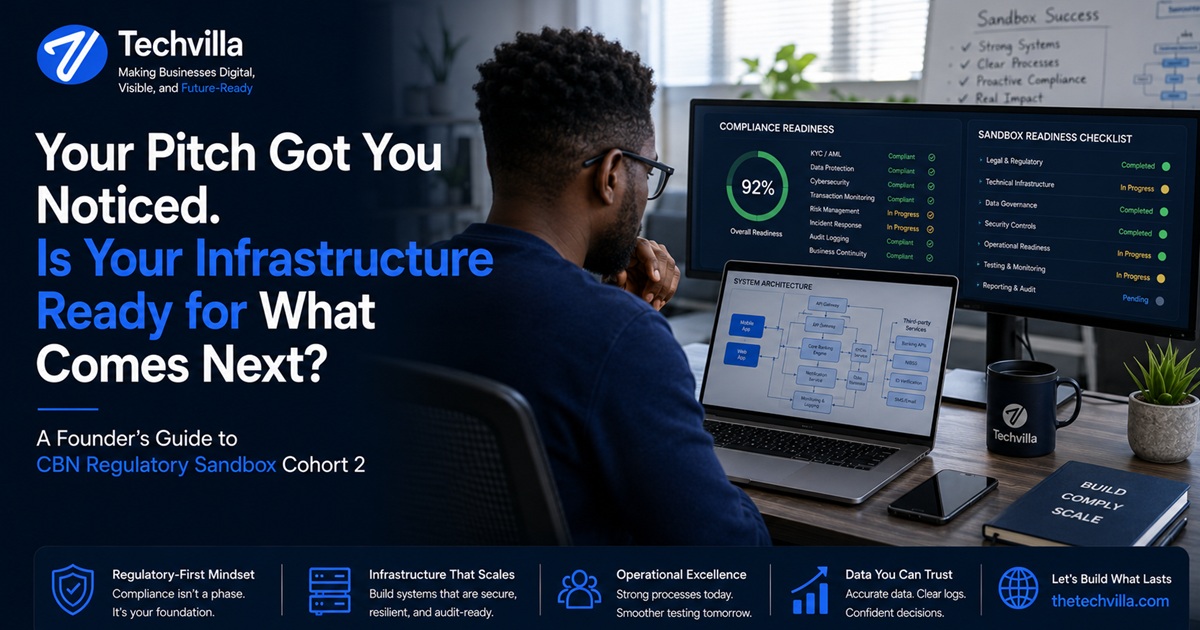
On August 12, 2026, the Central Bank of Nigeria opened applications for the second cohort of its Regulatory Sandbox Programme, giving fintechs, Virtual Asset Service Providers, and technology companies until August 31 to apply. If you are building a financial product in Nigeria right now, this is worth your serious attention, because most founders evaluating whether to apply are focused entirely on the product pitch and underestimating the technical infrastructure discipline the sandbox actually requires once you are in.
What Is the CBN Regulatory Sandbox, and Why Does Cohort 2 Matter?
The Regulatory Sandbox is a controlled environment where the CBN allows approved fintechs and innovators to test financial products, services, and business models with real customers, under direct regulatory supervision, before those products are approved for wider deployment. It exists specifically for innovations that do not yet fit neatly into existing CBN regulations, which makes it particularly relevant for founders building genuinely novel financial technology rather than incremental improvements on existing licensed products.
Cohort 2 introduces something the first cohort did not have: two distinct tracks. The Virtual Asset Service Provider Track covers virtual assets, stablecoins, payments, settlement, custody, and wallet infrastructure requiring supervised live testing. The Data-Enabled Financial Services Track, which explicitly excludes VASPs, covers innovations using secure digital infrastructure and permission-based data sharing to improve financial inclusion, credit, risk management, and payments.
This dual-track structure signals something important: the CBN is treating virtual asset infrastructure and data-driven financial services as distinct regulatory categories with different risk profiles, and your application needs to reflect an understanding of exactly which category your product actually belongs to.
How the CBN Actually Evaluates Applications
According to the CBN's own stated criteria, eligible organisations are assessed on the level of innovation, readiness for controlled live testing, potential benefit to consumers and the market, governance structures, risk management capabilities, and the suitability of the proposed testing plan.
Read that list again carefully, because four of those six criteria are not about your product idea at all. They are about whether your organisation is technically and operationally ready to be trusted with live customer data and real transactions under regulatory observation. A brilliant product concept with weak governance structures or an underdeveloped risk management framework is a weaker application than a more modest product backed by genuine operational discipline.
The Technical Infrastructure Discipline Founders Consistently Underestimate
This is where many fintech founders get caught out, often after approval rather than before it.
Sandbox participation comes with explicit safeguards the CBN expects participants to maintain throughout testing: consumer protection, operational resilience, cybersecurity, and regulatory reporting. These are not abstract principles. They translate into concrete technical requirements. Consumer protection means having a functioning complaints and redress mechanism, including the ability to compensate affected customers if something goes wrong during testing, not just a policy document describing one. Operational resilience means your systems need to stay stable and available throughout the testing window, not crash under load or during a routine update. Cybersecurity means your infrastructure needs to withstand scrutiny you may not have previously been tested against, since you are now handling real transactions under direct regulatory observation. Regulatory reporting means you need systems capable of producing accurate, timely data the CBN can review, on an ongoing basis, not just at the end of the testing period.
Founders who treat the sandbox as primarily a marketing or credibility opportunity, and who have not invested in the underlying infrastructure to actually support these obligations, tend to struggle once testing begins, or in worse cases, damage their standing with the regulator entirely.
What Founders Should Actually Prepare Before Applying
Before submitting an application by the August 31 deadline, it is worth honestly assessing whether your technical foundation matches your ambition. This means having genuinely secure infrastructure for handling customer data and transactions, not infrastructure that was adequate for a small beta but was never stress-tested for regulatory-grade scrutiny. It means having a real, documented risk management framework, not just a slide in your pitch deck. It means having systems capable of producing the reporting data the CBN will expect throughout the testing period, which often requires purpose-built software rather than retrofitting whatever internal tools got you to this stage.
This is precisely where many early-stage Nigerian fintechs need support they do not have in-house. Custom software built specifically around your actual workflow and compliance requirements, rather than generic off-the-shelf tools, is often the difference between a sandbox application that reflects genuine operational readiness and one that reads as aspirational.
Is Applying Worth It for Every Fintech?
Not automatically. Sandbox participation is optional, not a compulsory regulatory requirement, and it comes with real obligations attached, a maximum testing period of six months per cohort, ongoing engagement with the CBN throughout that window, and the operational overhead of maintaining the safeguards described above. For an early-stage founder still validating basic product-market fit, the sandbox may be premature. For a founder with a genuinely novel financial product and the operational maturity to support live regulatory testing, it can be a powerful way to build a direct relationship with the regulator and gain credibility that shapes how future regulation is written.
The honest question every founder should ask before applying is not "does my product idea qualify?" It is "can my infrastructure actually support what regulatory-grade testing demands?"
Getting your technical foundation genuinely ready for something like the CBN sandbox, not just your pitch, starts with an honest assessment of where your current systems stand.
At Techvilla, we help Nigerian fintechs and technology companies build the custom software and secure infrastructure that regulatory-grade testing environments like the CBN sandbox actually demand, so your application reflects real operational readiness, not just ambition.
Chat with us on WhatsApp or start a free consultation.
Because the goal is not just to build a website. The goal is to make your business digital, visible, and future-ready.
Need technical assistance?
I'm Techvilla Admin. We help businesses move from offline to online with simple, clear steps. If you have questions about this article or need help with your project, let's chat.