
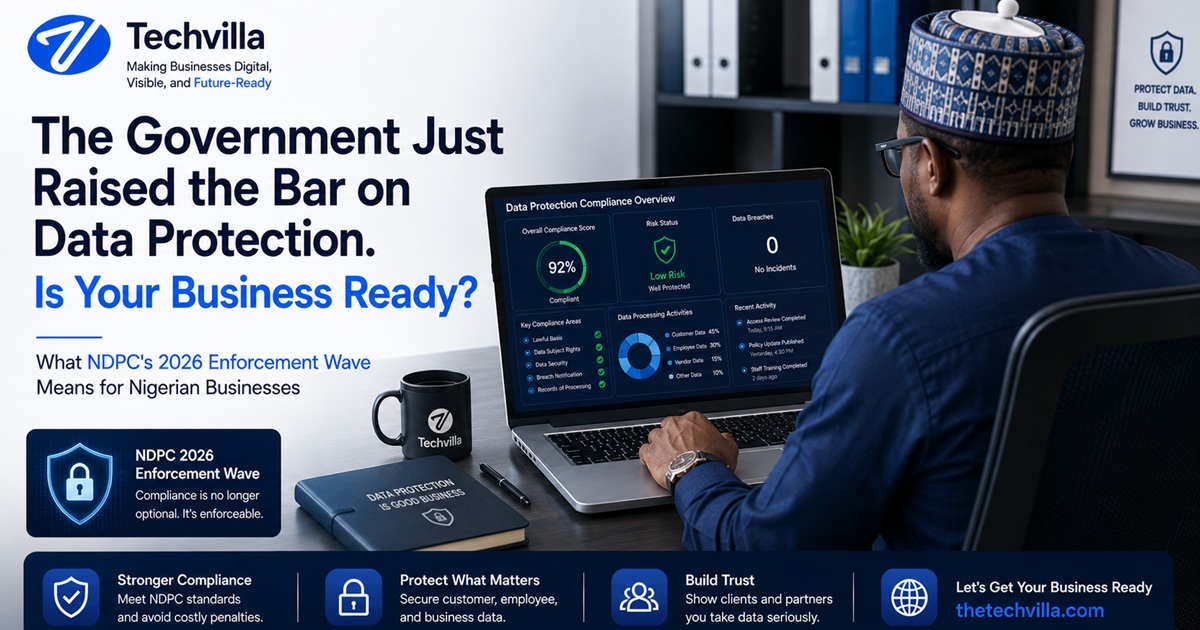
On August 4, 2026, the Nigeria Data Protection Commission announced that the Federal Government has issued a compliance circular directing every Ministry, Department, and Agency to fully comply with the Nigeria Data Protection Act. If you run a business in Nigeria and assumed this kind of directive only applies to government offices, it is worth pausing on what this circular actually signals, because the private sector is not exempt from what is happening here. It is simply next in line.
What the New Circular Actually Says
The circular, signed by the Secretary to the Government of the Federation and dated July 27, 2026, quotes President Bola Ahmed Tinubu directly: data is the new oil, and its value increases the more it is refined and responsibly shared. Every MDA has now been directed to capture information rigorously and safeguard it under the Nigeria Data Protection Act 2023.
The practical requirements are specific. Every MDA must designate a qualified Data Protection Officer, register that officer's details with the NDPC, engage licensed Data Protection Compliance Organisations where required, budget properly for compliance activities, and submit mandatory Data Protection Compliance Audit Returns within prescribed timelines. Perhaps most tellingly, the circular states plainly that permanent secretaries, accounting officers, and chief executive officers of all MDAs will be personally responsible for institutional compliance.
That last line is the one worth sitting with. This is not a polite suggestion. It is a directive with named personal accountability attached.
Why This Matters Even If You Are Not a Government Agency
Nigeria's data protection enforcement has been building momentum for over two years, and 2026 is the year the NDPC itself describes as full enforcement mode. Since the Nigeria Data Protection Act 2023 came into force, the commission has concluded more than 240 investigations into data breaches, resulting in eleven major enforcement actions, and has collected approximately ₦7.2 billion in fines and compliance revenue. Administrative fines under the Act can reach up to ₦10 million or 2 percent of a company's annual gross revenue, whichever is greater.
This enforcement drive has already reached well beyond government. In February 2026, the NDPC issued compliance notices to 649 higher education institutions, giving them just 21 days to submit proof of Data Protection Officer appointments and audit returns. In April 2026, the commission opened investigations into alleged large-scale data breaches involving major private companies over the possible compromise of sensitive personal and financial data. Nigeria is now being described by industry observers as one of Africa's most aggressive data protection enforcement environments.
The MDA circular you may have seen is not an isolated government memo. It is one visible data point in a much larger, deliberate pattern. If the Federal Government is holding its own permanent secretaries personally accountable for data protection compliance, it is a clear signal of how seriously the NDPC expects every organisation, private businesses included, to be treating this obligation.
What Does This Actually Mean for a Nigerian Business Owner?
Under the Nigeria Data Protection Act, any organisation that determines how and why personal data is collected and processed, referred to as a data controller, has direct legal obligations. This includes customer records, employee data, patient files, student records, transaction histories, and effectively any personal information your business stores or processes as part of normal operations.
Depending on the volume and sensitivity of data your business handles, you may be classified as a Data Controller or Processor of Major Importance, which brings specific registration obligations with the NDPC. Even businesses below that threshold are still expected to follow the Act's core principles around lawful, transparent, and secure data handling.
Why This Is a Technology Problem, Not Just a Legal One
Many business owners hear "data protection compliance" and immediately think it is purely a legal or paperwork exercise, something to hand to a lawyer once and forget about. In practice, real compliance depends heavily on the technical infrastructure behind how your business actually stores, secures, and controls access to data, which is where the legal obligation meets day-to-day technology decisions.
This connects directly to conversations we have already had in this series. Who has access to your website's hosting account is a data protection question, not just a technical one, since a compromised hosting account can expose customer data stored on your website. How your office manages internal access to sensitive files, something LANCore is specifically built to control, is directly relevant to demonstrating that your business restricts data access appropriately rather than leaving every staff member with equal, unmonitored access to everything.
Proper backups, secure server management, and a documented approach to who can see and change what within your systems are not just good IT practice anymore. They are increasingly the practical evidence a business would need to show if the NDPC came asking.
What Should a Nigerian Business Do Now?
Waiting until an enforcement notice arrives is the most expensive way to approach this. The businesses already facing NDPC investigations in 2026 did not expect to be the example. Getting ahead of this means understanding whether your business meets the thresholds that require formal NDPC registration, ensuring someone in your organisation is genuinely responsible for data protection oversight, and making sure your actual technical infrastructure, your website, your hosting, your internal systems, reflects the access control and security standards the law expects.
This last part is where a technology partner becomes essential, since legal advice alone cannot fix a poorly secured hosting account or an office network with no access controls in place.
At Techvilla, we help Nigerian businesses build the technical foundation that real data protection compliance depends on, from secure website hosting and managed IT support to internal systems like LANCore that give you genuine control over who accesses sensitive information. We cannot replace your data protection lawyer, but we can make sure the technology behind your compliance actually holds up.
Chat with us on WhatsApp or start a free consultation.
Because the goal is not just to build a website. The goal is to make your business digital, visible, and future-ready.
Need technical assistance?
I'm Techvilla Admin. We help businesses move from offline to online with simple, clear steps. If you have questions about this article or need help with your project, let's chat.