
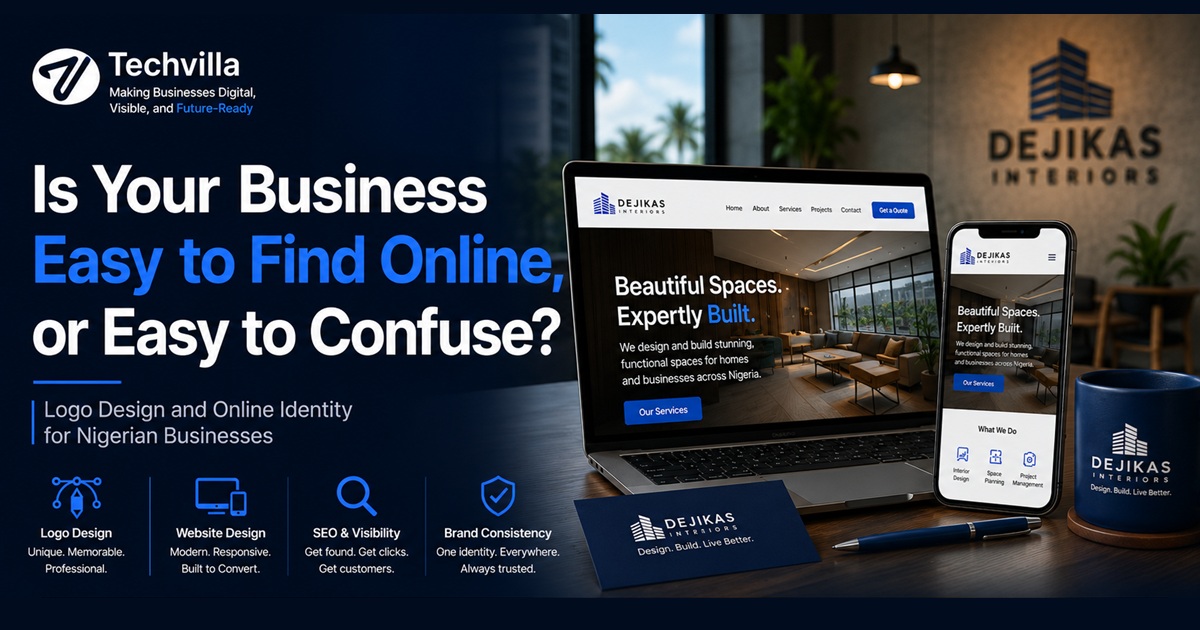
Your logo is usually the first thing people notice about your business, and in Nigeria's crowded market, that first impression can determine whether a potential customer trusts you or quietly moves on to a competitor. But a logo alone is only part of the story. The bigger challenge for most Nigerian businesses today is not just having a logo. It is making sure your entire online identity is distinct, consistent, and impossible to confuse with someone else.
The Brand Confusion Problem Nobody Talks About
Search for almost any business name in Nigeria and you will find something surprising: multiple businesses with nearly identical names, similar logos, and overlapping URLs all competing for the same search results. A customer who heard about your business through a referral searches for you online and lands on a competitor's website instead. They call the wrong number. They send an enquiry to the wrong email. They form an impression of your business based on someone else's brand.
This is not a rare scenario. It happens every day, and it costs businesses real money without them ever knowing it happened.
When Techvilla worked with Vorteil TS IT Ltd, a managed IT services company based in Ikoyi, Lagos, one of the first decisions was choosing vorteilhq.com as their domain rather than a more generic alternative. That choice was deliberate. "Vorteil" as a word has variations and near-matches that could easily create confusion online. By anchoring their official identity to a distinct domain and building their website with an explicit FAQ that directly states "vorteilhq.com is the official website of Vorteil TS IT Ltd," the business took ownership of its online identity in a way that leaves no room for confusion.
Your logo and your domain name work together as the foundation of that identity.
What a Logo Actually Does for Your Nigerian Business
A logo is the visual anchor of everything your business produces. Every time a customer sees it, on your website, your invoice, your social media page, your signage, your business card, or your vehicle branding, it either builds recognition and trust or quietly undermines it.
In Nigeria's competitive business environment, visual credibility acts as a shortcut. A customer who does not know you yet will make a snap judgement about your business based on how professional it looks. A poorly designed logo, or worse, no logo at all, can cost you a sale before you even get a chance to speak.
This is especially true online. A professionally built business website puts your business in front of people actively searching for what you offer. But if the logo on that website looks rushed or amateurish, the credibility your website is supposed to build disappears immediately.
Why Consistency Across Your Online Presence Matters
A logo is most powerful when it appears consistently across every surface your brand occupies. Your website, your social media pages, your email signature, your WhatsApp Business profile, your printed materials: all of them should feel like they belong to the same business.
When they do not, customers notice, even if they cannot articulate why. Inconsistent branding creates a subtle sense of unreliability. It suggests that the business may not have the same attention to detail in its products or services either.
This is why website design and brand identity work best when they are planned together, not separately. A logo designed without considering how it will appear on a website often creates problems later. The colours may not translate well on screen. The design may not scale properly to a small favicon. The visual style may clash with the layout of the website it eventually sits on.
What Makes a Logo Design Strong or Weak?
A strong logo works at any size. It looks sharp on a billboard and equally sharp as a tiny icon on a mobile screen. It works in colour and in black and white. It is simple enough to be recognised at a glance but distinctive enough not to be confused with a competitor.
A weak logo tends to have too many colours, too many fonts, too many elements, or generic clip art that was not created specifically for the brand. It may look acceptable on screen at first glance but falls apart when printed on a pen, embroidered on a shirt, or displayed as a website header.
Many Nigerian business owners choose a logo based on personal preference rather than on how their target customers will perceive it. Your logo is not for you. It is for the people you want to attract and retain.
When Is the Right Time to Get This Right?
The best time is before you launch. The second best time is right now, if what you currently have is not doing your business justice.
Rebranding later costs more and disrupts more than getting it right from the start. You will need to update your website, your social media pages, your stationery, your signage, and your printed materials all at once to avoid a split visual identity in the market, which itself creates the brand confusion problem we described at the beginning.
Whether you are starting fresh or refreshing an existing brand, the goal is the same: a visual identity that is distinct, consistent, and immediately recognisable as yours, not a near-match for someone else's.
Getting your brand identity right in Nigeria starts with working with a team that understands your market, your competitors, and how to make your business visually unmistakable.
At Techvilla Technologies, we design logos and brand identities for Nigerian businesses across every sector, and we build them to work seamlessly alongside your website, your domain strategy, and your wider online presence. Everything designed to work together from day one.
Chat with us on WhatsApp or start a free consultation.
Because the goal is not just to build a website. The goal is to make your business digital, visible, and future-ready.
Need technical assistance?
I'm Techvilla Admin. We help businesses move from offline to online with simple, clear steps. If you have questions about this article or need help with your project, let's chat.