
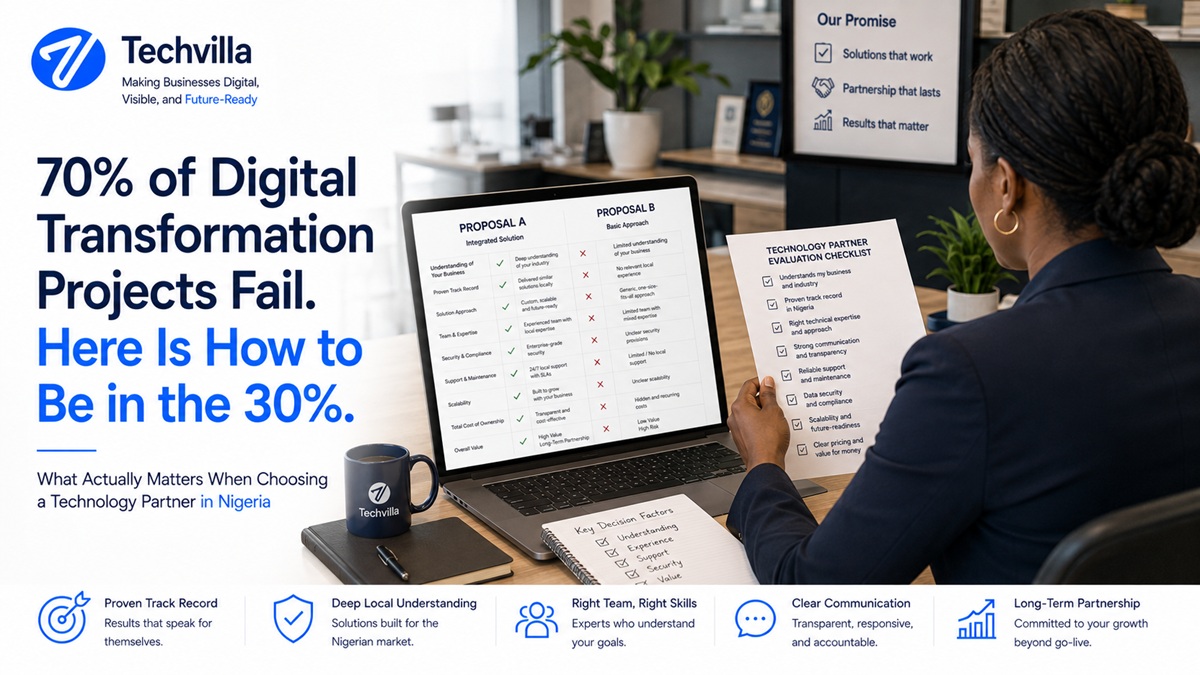
Roughly 70 percent of digital transformation projects fail to meet their objectives, a global figure that costs organisations an estimated 2.3 trillion dollars annually, and Nigerian research points to a specific reason why. A study across 144 Nigerian SMEs found that skills shortages and governance gaps, not cost, are the biggest barrier to successful technology adoption. In plain terms, most businesses are not failing because they cannot afford good technology. They are failing because they chose the wrong partner to help them get there.
With Nigeria's digital economy now estimated at 14 billion dollars and growing roughly 18 percent annually, more businesses than ever are making this decision. Here is what actually separates a technology partner worth trusting from one that will quietly cost you far more than the invoice suggests.
They Treat Your Business Strategy as the Starting Point, Not the Software
One of Nigeria's leading digital transformation voices put it plainly at a recent business innovation conference in Lagos: transformation must be led by business strategy, not delegated to IT as a standalone project. A technology partner worth working with starts every engagement by understanding what your business is actually trying to achieve, more customers, faster operations, better data, reduced costs, rather than jumping straight into recommending tools and features.
If a prospective partner never asks about your business goals before quoting you a solution, that is a warning sign worth taking seriously. Solutions built without that understanding tend to be technically functional but strategically useless, technology for technology's sake.
They Are Honest About What Your Business Actually Needs
A trustworthy technology partner tells you what you need, not what generates the biggest invoice. This shows up in small but telling ways: do they recommend a simpler, more affordable solution when that genuinely fits your stage of growth, or do they push the most expensive option regardless of fit? Do they explain trade-offs honestly, including where a cheaper approach might mean revisiting the decision again in a year, or do they oversell certainty they cannot actually guarantee?
Getting a clear, complete quote upfront, with everything included explicitly stated rather than buried in fine print or added later, is one of the simplest, most reliable signals of how honestly a partner operates.
They Understand Nigeria's Actual Operating Conditions
Generic advice from a generic playbook does not survive contact with Nigerian business realities. Unreliable power, inconsistent internet, and infrastructure gaps are not edge cases here, they are daily operating conditions every serious technology partner needs to design around from the outset, not treat as an afterthought once something breaks.
A partner who understands this builds with these realities in mind from day one, systems that keep working through outages, infrastructure resilient to power fluctuations, and hosting choices that account for local performance rather than defaulting to whatever is easiest to set up.
They Take Security and Access Seriously, Not as an Afterthought
Who controls your hosting account, your servers, and your sensitive business data is one of the most consequential decisions in any technology partnership, and it is also one of the most commonly overlooked. A serious partner has clear, demonstrable practices around access control, secure credential management, and ongoing security updates, and they can explain these practices to you in plain language rather than vague reassurance.
This matters even more given how seriously Nigerian data protection enforcement has intensified. A partner who cannot speak confidently about how they secure client data and systems is a partner exposing your business to risk you may not discover until it is too late.
They Think About What Happens After Launch, Not Just Delivery
The research on Nigerian digital transformation failures is consistent on this point: the biggest barriers are not upfront cost, they are skills gaps, weak governance, and poor ongoing adoption. A technology solution that works perfectly on delivery day but has nobody responsible for maintaining, updating, and adapting it over time is a solution quietly heading toward failure.
Ask directly what support looks like after the project is delivered. Is there a defined support period? What happens once it ends? Who do you call when something breaks at an inconvenient time? A partner who has a clear, confident answer to these questions is thinking about your long-term success, not just closing the deal.
They Give You Full Ownership, Without Conditions
Full ownership of your website, your systems, your data, and your accounts should transfer to you completely once a project is delivered, with no strings attached and no dependency on the original developer to make basic changes later. If a partner hesitates on this point or structures things so you remain dependent on them indefinitely, that dependency is often more about their business model than your business's best interest.
The Real Cost of Choosing the Wrong Partner
Given that Nigeria's digital economy contributed over 7 trillion naira to GDP in the first half of 2025 alone, the businesses getting technology partnerships right are not incidental winners. They are capturing real, measurable value that businesses stuck with failed implementations, fragmented systems, and vendor dependency are quietly losing.
Choosing a technology partner in Nigeria is rarely about finding the cheapest quote or the flashiest pitch. It is about finding a partner whose incentives, transparency, and understanding of Nigerian operating realities genuinely align with your business succeeding long after the invoice is paid.
At Techvilla, every one of these principles is not a marketing claim, it is how we structure every client relationship, from the first strategy conversation to the ownership handover and everything in between.
Chat with us on WhatsApp or start a free consultation.
Because the goal is not just to build a website. The goal is to make your business digital, visible, and future-ready.