
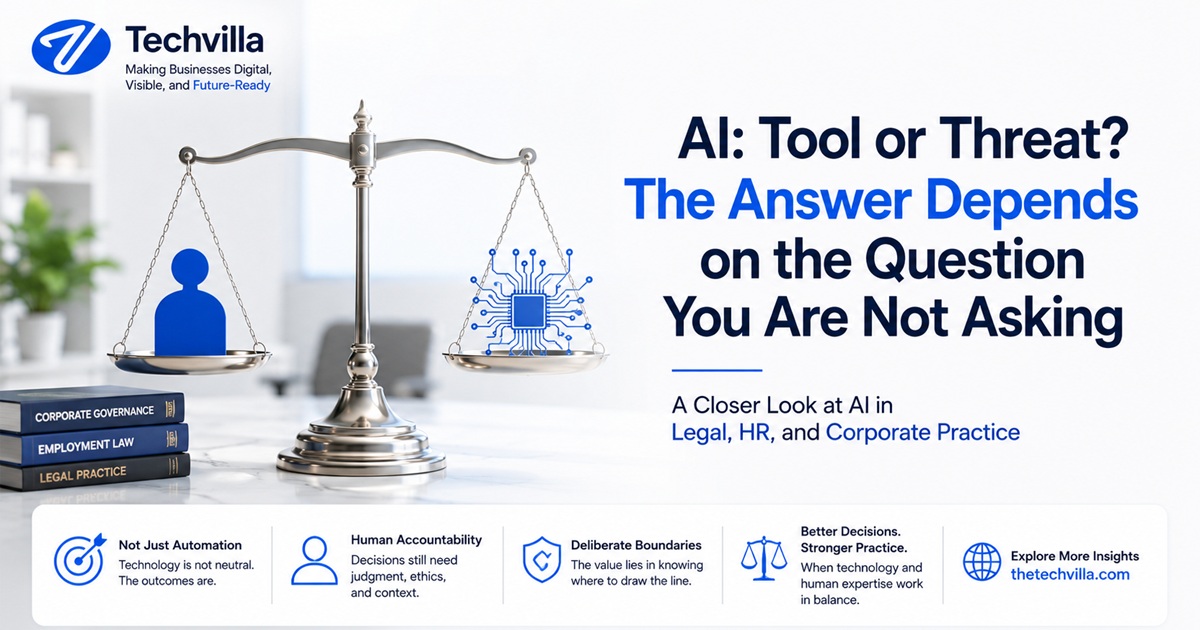
Walk into any law firm, HR department, or corporate boardroom in Nigeria today, and you will find two conflicting reactions to AI happening simultaneously. One group is quietly terrified, convinced that AI is coming for jobs, expertise, and the value professionals have spent decades building. The other group is racing to adopt anything with "AI" in the name, convinced that whoever moves fastest wins, regardless of whether the tool actually fits the problem.
Both reactions are understandable. Both are also, in different ways, missing the more useful question. The real question is not whether AI is a tool or a threat. It is under what conditions AI becomes one or the other, and who gets to decide that for a given profession, organisation, or individual career.
The Case That AI Is a Genuine Threat to Professional Services
This argument deserves to be taken seriously rather than dismissed. Much of professional services work, legal research, contract review, first-draft policy documents, routine HR correspondence, candidate screening, has historically been billed or valued precisely because it took a trained human significant time to do it well. AI systems can now do meaningful portions of that work in a fraction of the time.
For a junior associate at a law firm whose early career value came from spending hours on case research, or an HR officer whose role involved manually screening hundreds of CVs, that is not an abstract concern. It is a direct challenge to how their profession has historically justified its cost and structured its career ladder. If a task that once took a paralegal a full day now takes an AI system twenty minutes, the economics of that role, and the training pathway that role once represented, genuinely changes.
There is also a deeper concern worth naming honestly: professions built on judgement, discretion, and human accountability, law, HR, governance, carry real risk when decisions with serious consequences are outsourced to systems that cannot be cross-examined, cannot explain their reasoning in a courtroom, and cannot be held personally accountable the way a licensed professional can. An AI system recommending who to hire, fire, or promote, or drafting a legal argument, is not a neutral efficiency gain if nobody meaningfully understands or takes responsibility for how it arrived at its conclusion.
The Case That AI Is Simply a Tool, No Different From What Came Before
The counterargument is equally serious. Every meaningful leap in professional tools throughout history has automated something that used to require significant human time, and professions did not disappear as a result. They evolved.
Legal research once required physically searching through printed law reports and digests. Digital legal databases made that dramatically faster, and lawyers did not become obsolete. They redirected the time saved toward analysis, strategy, and client relationships, the parts of the job that actually required judgement rather than search. HR departments once processed payroll by hand. Payroll software did not eliminate HR. It freed HR professionals to focus on culture, retention, and people strategy instead of arithmetic.
Seen this way, AI is simply the next tool in that same lineage; a more powerful one, certainly, but fundamentally continuing a pattern where the mechanical, repetitive parts of professional work get automated so that the human parts, judgement, empathy, accountability, relationship, can receive more attention rather than less.
Where Both Sides Are Actually Right
The honest position is that AI is genuinely both, and which one it becomes depends heavily on how deliberately an organisation approaches it.
AI becomes a threat when it is adopted carelessly: when a firm lets an AI system draft final legal advice without qualified review, when an HR department lets an algorithm make hiring decisions without human oversight for bias, or when leadership adopts AI purely to cut headcount rather than to elevate the quality and speed of the work their people do. In those scenarios, the threat is real, and it is often self-inflicted through poor implementation rather than the technology itself being inherently dangerous.
AI becomes a genuine tool when an organisation is clear-eyed about what it should and should not be trusted to do. Used well, AI can flag the ten most relevant precedents for a lawyer to personally review and argue, rather than replacing the lawyer's judgement on which one actually applies. It can surface candidates who match a role's requirements for an HR professional to personally interview and assess, rather than replacing the human judgement of whether someone will actually thrive in that culture. In both cases, the professional's expertise is not sidelined. It is focused on exactly the part of the work that most needed it in the first place.
The Uncomfortable Middle Ground Most Companies Avoid
Here is the part that gets left out of most corporate AI conversations: adopting AI well requires organisations to be honest about which parts of their work are genuinely repetitive and mechanical, and which parts depend on human accountability and judgement that should never be delegated away. That is an uncomfortable conversation, because it forces leadership to be specific rather than sweeping. "We are adopting AI across the business" sounds decisive. "We are automating first-pass document review but keeping every final legal opinion under a named partner's signature" is a harder, more honest sentence to say, and it is the one that actually protects both efficiency and accountability.
Most organisations skip this harder conversation entirely, either rejecting AI wholesale out of fear, or adopting it wholesale out of trend-chasing. Both are avoidance dressed up as a decision.
Where Techvilla Stands in This Conversation
At Techvilla, we do not believe our role is to convince every client that AI is either the answer to everything or a danger to avoid entirely. Our role is to help each organisation have the harder, more specific conversation: what in your operation is genuinely repetitive and safe to automate, and what depends on human judgement and accountability that technology should support, not replace.
This is precisely why our approach to technology for law firms focuses on giving lawyers better tools for organising records and managing case information, not on replacing the judgement that sits at the centre of legal practice. It is also why systems like LANCore are built around giving organisations structural control over their own information and workflows, rather than handing that control over to a black-box system nobody in the business fully understands.
Where AI genuinely fits a client's specific operations, we help implement it thoughtfully, tailored to their actual workflows and domain expertise. Where it does not, or where the risk of getting it wrong outweighs the efficiency gained, we say so honestly, even when that is not the trendy answer.
The question every professional services firm and corporate leader should be asking is not whether AI is a tool or a threat in the abstract. It is which parts of their own work fall on each side of that line, and whether they are being honest enough with themselves to tell the difference.
At Techvilla, we help businesses and professional services firms navigate that distinction clearly, building and implementing technology that strengthens human expertise rather than quietly replacing the accountability that expertise is supposed to carry.
Chat with us on WhatsApp or start a free consultation.
Because the goal is not just to build a website. The goal is to make your business digital, visible, and future-ready.
Need technical assistance?
I'm Techvilla Admin. We help businesses move from offline to online with simple, clear steps. If you have questions about this article or need help with your project, let's chat.