
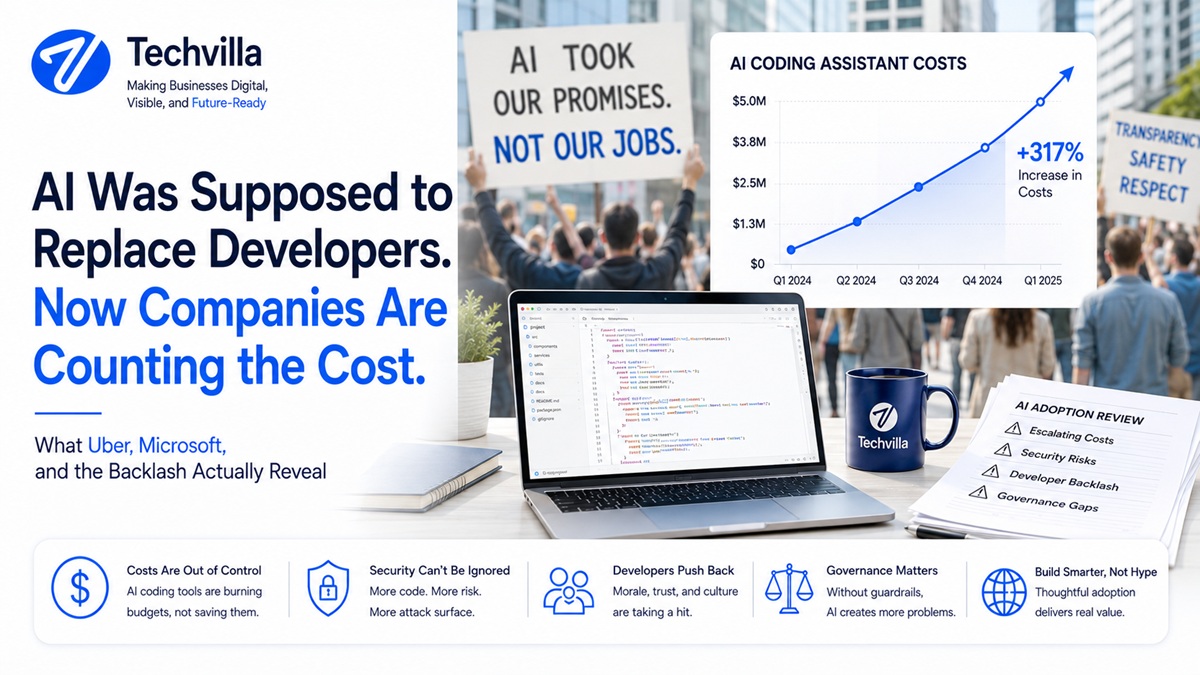
Two years ago, the dominant narrative in tech was that AI would replace software developers outright. Executives predicted junior engineering roles would vanish. Some declared the profession itself was on borrowed time. In 2026, the story has taken a sharp and expensive turn. The companies that rushed hardest into AI coding tools are now the ones publicly admitting the costs do not add up, the security risks are real, and their own engineers are burning out under a technology that was supposed to make everything easier.
The Cost Problem Nobody Predicted
Uber's Chief Technology Officer recently disclosed that the company burned through its entire 2026 AI coding budget in just four months. By March, 84 percent of Uber's engineers had adopted Claude Code, and roughly 70 percent of committed code came from AI. The usage was enormous. What the usage actually delivered was murkier, with Uber's own COO stating publicly that token consumption did not correlate directly with useful features shipped to users.
Microsoft, which has invested roughly 13 billion dollars in OpenAI and writes up to 30 percent of its own code using generative AI, instructed engineers in a major division to stop using an AI coding assistant entirely because the bills became untenable.
Gartner now forecasts that by 2028, AI coding costs will overtake the average developer's salary, driven by the industry's shift from predictable subscription pricing to consumption-based token billing. Gartner's senior principal analyst put it plainly: costs that once ran 20 dollars a month per developer are climbing toward 200, sometimes 2,000, and in extreme cases as high as 20,000 dollars in token charges for a single developer in a single month. Research has found that a striking share of tokens consumed during AI coding sessions, in some analyses as much as 70 percent, is pure waste, the tool re-reading files, repeating searches, and exploring irrelevant code paths rather than producing anything useful.
This is precisely the trap we described when this AI conversation first started: a business chasing a trend without asking whether the tool genuinely fits the problem in front of it, only now the bill has arrived and the answer is visible in the accounting.
The Privacy Problem Companies Underestimated
Beyond cost, a second, quieter crisis has emerged around proprietary code and data exposure. Security researchers have found hundreds of thousands of publicly accessible applications built with AI coding tools, some containing sensitive corporate data, medical records, and internal documents that were never meant to leave the company. Separately, security analysts warn that AI coding assistants with whole-repository access read a company's entire codebase, including configuration files, internal API definitions, and forgotten credentials, transmitting all of it during ordinary use. Developers rarely think of asking an AI assistant to explain or refactor a pricing engine or fraud detection model as "sharing data", but that is precisely what is happening, piece by piece, one ordinary interaction at a time.
For any company whose competitive advantage lives inside its proprietary logic, and that describes most serious technology businesses, this is not an abstract risk. It is a direct threat to the intellectual property the business was built on.
The Human Backlash Nobody in Silicon Valley Expected
While companies wrestle with the economics, a genuine human backlash has been building in parallel. In July 2026, protesters marched through San Francisco chanting "we don't want a robot war", stopping outside the offices of OpenAI, Anthropic, and Google DeepMind. A Stanford Institute for Human-Centered AI report released this year found that a third of organisations expect AI to shrink their workforces, with software engineering among the categories facing the highest anticipated cuts. Separately, a consumer boycott movement has drawn over 1.5 million participants globally, and polling shows a majority of adults now believe AI will cost jobs and cause more harm than good in their daily lives.
The protest chants have not literally been "kill a robot," but the sentiment behind them is unmistakable: a growing number of people, including engineers who helped build these tools, believe the technology is being deployed faster than its consequences are being reckoned with.
What This Actually Confirms, Rather Than Contradicts
None of this means AI coding tools are worthless. It means the industry is now living through exactly the correction our earlier piece on AI hype predicted: a technology adopted everywhere at once, with genuine capability, but deployed by many organisations without the domain expertise, cost discipline, or security judgement to use it well. Uber did not fail because Claude Code does not work. Uber's own leadership admitted the failure was that usage never correlated cleanly with outcomes, exactly the gap between adoption and value that separates a tool being used thoughtfully from a tool being used because everyone else is.
The businesses genuinely benefiting from AI coding tools in 2026 are not the ones that adopted fastest. They are the ones treating it the way we described from the start: a tool that amplifies real engineering judgement and genuine understanding of the codebase, not a replacement for either. That requires deliberate governance around cost, deliberate controls around what proprietary code an AI tool is ever allowed to see, and honest conversations about which tasks genuinely benefit from automation versus which ones simply generate an impressive-looking bill.
Where Techvilla Stands
This is exactly the discipline we described building into our own approach from the beginning. At Techvilla, when we build custom software for clients, we do not treat AI adoption as a box to tick. We evaluate whether it genuinely improves the outcome for that specific business, we build with proprietary code protection in mind rather than as an afterthought, and we stay honest with clients about cost, including the real, escalating cost structures the wider industry is now publicly grappling with.
The lesson from Uber's four-month budget burn and Microsoft's internal rollback is not that AI failed. It is that adopting powerful tools without domain expertise, cost governance, and security discipline fails, regardless of how capable the underlying technology is.
At Techvilla, we help businesses build and adopt technology, AI included, with the judgement and governance that separates genuine value from an expensive trend followed too quickly.
Chat with us on WhatsApp or start a free consultation.
Because the goal is not just to build a website. The goal is to make your business digital, visible, and future-ready.
Need technical assistance?
I'm Techvilla Admin. We help businesses move from offline to online with simple, clear steps. If you have questions about this article or need help with your project, let's chat.